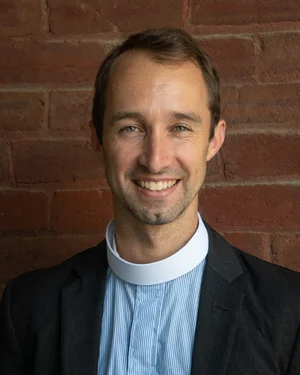
Sam Bush, “Why Jesus Died on the Cross”
Let me ask you something: Are you a responsible person? Do you always get to work on time? Do you try to stay up-to-date on current events? Are your pets neutered? Everyone feeling good? Because those were soft balls; just a few more questions. Have you ever bought an expensive bottle of wine when you could have spent that money supporting a family in Bangladesh? Have you ever kept a secret from your spouse because you didn’t want them to get angry? Have you ever texted while driving? I think it just got a little hot in here.
Responsibility can be a tricky thing to pin down. We all want to be considered responsible people, but it’s hard to define what a person is responsible for. Are you responsible for the state of the world? Are you responsible for the wrongs your children make? Are you responsible for the wrongs you have made unknowingly?
Believe it or not, these questions tie in with today’s gospel reading. Let me take you off the hot seat and pivot to this scene. John the Baptist is with his disciples when he sees Jesus walking toward him and he says, “Here is the Lamb of God who takes away the sin of the world!” What a strange thing to say! He says it twice in this passage! We use the phrase Lamb of God in church all the time, but what does it mean? Could you use it in a sentence?
Well, back then, the blood of the lamb was God’s currency to escape judgment. Most famously, on the first Passover, when God rescued the Israelites from the ruthless oppression of Egypt, he instructed each family to sacrifice an unblemished lamb and to smear its blood on the doorframe as a sign for the Lord to “passover” so that the firstborn son in that house would not die. Egypt was the biggest superpower the world had ever seen and God’s power cut through it with one fell swoop. Only the sons of the Israelites, whose doorways had been smeared with the blood of the lamb, were spared. This is, at least partially, what John the Baptist is referring to. It is not a metaphor. We’re talking about an actual lamb with actual blood that saved actual people from actual death. Passover remains the master story of the Jewish people who celebrate it every year with bread, wine and a lamb to commemorate their rescue and redemption.
In our society, few of us ever have to see an animal die. We are rarely confronted with the reality that death is required for life. So you may be thinking, “That’s not fair! The lamb didn’t do anything wrong! Why does it have to die?” People often say the same thing about Jesus’ death. Why can’t God just sweep everything under the rug? Why does Jesus have to die on a Cross? Why does God have to be so dramatic?
Let me ask you: Have you ever been kept up at night thinking of someone who has wronged you? Have you ever regretted saying or doing anything? Have you tried just sweeping it under the rug? If so, how’s that working out? From my own experience, if you don’t deal with unresolved conflict it will deal with you. I’ll give you an example.
The hit novel from last summer, Culpability, by UVA professor Bruce Holsinger, revolves around the Cassidy-Shaw family after their autonomous minivan crashes on the highway, killing two people (the crash happens on page 4, so don’t worry, I’m not really spoiling anything). As an investigation unfolds, each member of the family comes to terms with how they may have been responsible. Who exactly is to blame? The seventeen-year-old at the wheel? The father next to him, emailing on his laptop? The other passengers being distracting? The vehicle’s algorithm, designed to keep people safe? Everyone is kind of culpable but what happens when nobody takes the blame? The guilt has to go somewhere.
Lorelei, the mother of the family, is an AI ethicist and a rule follower who is hyper-driven to do the right thing every time. Once, when her husband Noah is lenient with their kids without telling her, she furiously calls him out. “You’re afraid of your own responsibility, Noah,” she says. “You’re afraid of my anger when I find out that you’ve evaded it. You’re afraid of anything that makes you look like less than a perfect husband and father. And it makes you sneaky as hell.” I felt chastened just by reading it. If you want to see how easily the most put-together family can be thrown into total chaos, read the book. Or look at your own life.
What happens in your own life when nobody takes the blame? It happens all the time! Excusing ourselves is second nature. We have an anger problem because our father had an anger problem. Maybe you’ve heard the line, “Don’t blame the parents, blame the grandparents.” That can be a genuinely helpful approach to feel more compassion toward your own parents, to take them off the hook. But how long until all the world’s blame gets passed back to the original culprits? Are Adam and Eve responsible for everything? When we pass the guilt down the line like a hot potato, where does it end up? It has to go somewhere.
Even self-criticism is not the answer. Maybe you’re someone who is always taking the blame, always apologizing, always beating yourself up. Oscar Wilde once said, “There is luxury in self-reproach. When we blame ourselves, we feel no one else has a right to blame us.” In other words, no one can point a finger at us as long as we beat them to the punch. We are so hardwired to placate judgment that we will throw ourselves under the bus before being thrown by someone else. Even then, as the bus drives away and we pick ourselves back up, we find that the guilt remains and has likely festered into shame and resentment.
Truth be told, we are often more responsible for life’s hardships than we’d like to admit. You can pass the guilt around all we like, but to think that you are not culpable for anything at all may be getting in the way of coming to terms with reality. Sometimes accepting responsibility can provide a sense of peace. The reason why we are so averse to doing that is fear of judgment. Hence, the lamb.
In the end, someone needs to take the blame. Of all the wrongs in the world. From petty jealousies to horrifying genocide. They all need to be dealt with. Even in our hi-tech age, machines are useless when it comes to fear and shame. Early on in that book Culpability, Lorelei is speaking about AI and bemoans the limits of the almighty algorithm. She writes, “It may think for us, it may work for us, it may organize our lives for us. But the algorithm will never bleed for us. The algorithm will never suffer for us. The algorithm will never mourn for us.” She is implying, perhaps unknowingly, that we need someone who will.
The night he was betrayed Jesus celebrates the Passover meal. He stands up, takes the place of the presider who would guide everyone through the meal. Everyone there knew there would be three essential things on the table - unleavened bread, wine, and a lamb. Jesus takes the bread and breaks it. He takes the cup of wine and gives it to them. But something’s missing. There’s no lamb! The disciples would have noticed this. Where’s the lamb! The lamb is not on the table because the lamb is at the head of the table. In just a few hours, the Lamb of God would be sacrificed to take away the sin of the world. This was not a metaphor. We’re talking about the actual Lamb who actually died for your actual sins so that you will actually be saved. As Isaiah prophesied, “Like a lamb he was led to the slaughter, and like a sheep that is silent in front of its shearers, he did not open his mouth.”
Friedrich Nietzsche once said, “To take upon oneself not punishment, but guilt — that alone would be godlike.” If only someone had told him about the Cross, where our transgressions were removed, once for all. They did not get passed down the line but were eliminated altogether. And where exactly did they go? As 1 Peter says, “He himself bore our sins in his body on the cross.” Jesus, the one person who was not responsible for the sins of the world, took our responsibility on his shoulders. While we were the culprits, Jesus accepted culpability. It was anything but fair, but fairness is not his priority. You are.
What does this have to do with your life right now? Well, of course, you have responsibilities. You have people in your life to care for - children, parents, clients, patients. But you can care for them while knowing that the Lamb has taken full responsibility. And there are things you have done that you may be responsible for, (that’s between you and God), but if you are you can finally admit to without fear of judgment because they’ve all been dealt with, put to rest on the Cross and taken to the grave. That’s the reality of your situation. It’s been said that “Reality is that which, when you stop believing in it, doesn’t go away.” Whether you believe it or not, whether you like it or not, the Lamb of God has taken away the sin of the world.
So who’s responsible for the state of things right now? Who’s answerable for our broken lives? For some things, we are. For a lot of things we can’t be fully sure. But one thing we can be sure of: Jesus takes the blame.
Amen.