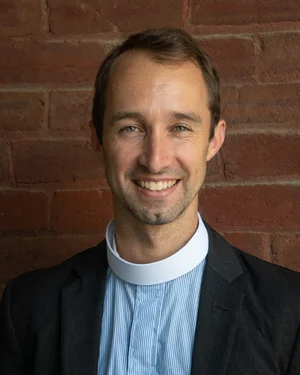
Sam Bush, “Passing the Test”
Back in 2005, during my first semester at UVA, I took Intro to Economics. I found the lectures engaging, but a little hard to understand. Still, for the first midterm, I walked in optimistically. I walked out far more somber. I totally bombed it. But the second midterm score outweighed the first so, a few weeks later, I met with the T.A. and studied with friends. But the only thing I gained a better understanding of was the law of diminishing returns. As luck would have it, it was announced that if anyone scored better on the Final Exam, the score of the midterms would be nullified. Clean slate! There was hope yet! Sadly, as hard as I studied, the light bulb never turned on. I ended up passing…with a D-. Thankfully, there were plenty of spots in the English and Religious Studies departments. Which is why I’m here today!
Have you ever tried (I mean really tried!) to make something work, but it just doesn’t pan out? A career? A relationship? Parenting a child? Controlling an addiction? We have officially begun the season of Lent which is known for being a time when people buckle down on spiritual disciplines, denying themselves creature comforts and striving to pray more or at least feel guilty for not praying more. The trouble with this pursuit of piety is that it often runs on willpower, a marvelous force when its wind is at your back, but a nonrenewable energy. The sacred text of the religion of willpower is The Little Engine That Could, the seminal story of optimism and perseverance, but have you ever heard of its counterpart The Little Blue Engine by Shel Silverstein? It starts with the same cheery confidence as the original, but this is how it ends:
With a squeak and a creak and a toot and a sigh,
With an extra hope and an extra try,
He would not stop — now he neared the top —
And strong and proud he cried out loud,
“I think I can, I think I can, I think I can!”
He was almost there, when — CRASH! SMASH! BASH!
He slid down and mashed into engine hash
On the rocks below... which goes to show
If the track is tough and the hill is rough,
THINKING you can just ain’t enough!
Welcome to Lent, everyone! Thankfully, today’s gospel reading has a hopeful word to anyone who has crashed and burned.
Let’s set the stage: Jesus, his hair still wet from his baptism, is whisked away by the Holy Spirit into the wilderness where he fasts and prays for forty days and nights. By then, Jesus would have been famished, exhausted and totally alone. Who should come along but the tempter, the devil. Satan smells blood in the water.
He gets right to the point: “If you are the Son of God, command these stones to become loaves of bread.” Now, for the Creator of the Heavens and the Earth, it is a small ask to turn rocks into bread. Still, Jesus refuses. “It takes more than bread to stay alive,” he says. “God fills my deepest needs through His word.” Satan recalculates and tries another approach. He takes Jesus to Jerusalem, sits him on top of the Temple and urges him to show his power. “Look,” he says, “if you jump, the angels will catch you. Everyone will see that you’re God. Think of the exposure you’ll get!” Jesus says, “Don’t you dare. My Father is not a puppet for some PR campaign.” For his final test, Satan brings Jesus to the top of a mountain that overlooks the kingdoms of the world and says, “Look, we both know that I have a lot of influence down here. If you just drop a knee and worship me, just for a second, I’ll hand it all over to you.” Jesus says, “Beat it, Satan!” and quotes scripture again: “Worship the Lord your God and serve only him.” Satan cuts his losses and leaves.
What is this all about? Well, here’s my take: this is the source of all evil and the source of all good arguing over their different philosophies of power. Satan believes in using power to get the job done. He’s saying, “Look, Jesus, I know you have power. Use it! Think of how many people would worship you if they saw you jump from the temple tower without a single scratch. Think of how easy it would be to save the world with a little bend of the knee – no Cross, no suffering, the world on a platter, painfree.”
It’s the same ace up his sleeve he used on Adam and Eve. “You’re just going to let that fruit sit there when you could be like God? You’re not realizing your full potential!”
At this point, Satan seems to be making a lot more sense than Jesus. He’s speaking our language. We are hellbent on the idea that power is the way to get things done. If we just had a little more power, we could fix our lives, we could change the world. If we had a little more power in the Senate or the Supreme Court, we could really make some changes. If we had a little more money, we’d have control over our finances. We could be a happy family if my children just respected my authority (that’s just some comic relief thrown in).
You see why our feeble willpower has no chance over the power of Sin? Oscar Wilde once said, “I can resist anything but temptation.” You know why that’s true? Because at the very heart of temptation is the quest for control, to bypass suffering and to be like God. Being in control and bypassing suffering sounds genuinely great to me, but not to Jesus. As Robert Capon says, “The Devil in the wilderness offers Jesus a short cut. Jesus calls it a dead end.” Tragically, Satan never understands.
More tragic still, neither do we. “If you are the Son of God, turn these stones to bread” is a different version of what we cry out, “If you are God, do something!” And yet, to our bafflement, it often feels like God does nothing. Even as we shouted on Good Friday: “If you are the Son of God, come down from the Cross!” what does Jesus do? He quotes Scripture once more, “My God, why have you forsaken me!” and then dies.
Here’s the thing: where do our efforts ever really get us? One of three places: either self-righteousness, a world of trouble or total despair. The 18th century English writer, Samuel Johnson, was incredibly accomplished in his time - he helped popularize the dictionary - and he was a devoted Christian, but his journal gives insight into his attempts at self-betterment. At the age of 29, he wrote in his journal “Lord, enable me… to redeem the time which I have spent in sloth.” Nineteen years later, he wrote, “Lord, enable me to shake off idleness and sloth.” Five years later, age 55: “I have made no reformation. Grant me O God to amend my life, to avoid idleness, to rise early, to read the Scriptures.” Two months later: “I resolve to rise early, not later than six if I can.” A year later: “I purpose to rise at eight! Because though I shall not rise early it will be much earlier than I now rise, for I often lie till two.” Try as we might, we will never pass the test. Willpower is not powerful enough. We need a higher power. More still, we need a higher power to descend from on high. Thankfully, as our collect declared today, Jesus is not a private tutor or an example to follow, but mighty to save. How? By taking the test on your behalf. By entering into weakness and death for you. Wherever you have crashed and burned, Jesus meets you to redeem your failures. Where you fail, Jesus succeeds on your behalf.
A friend of mine, Connor Gwin, taught a course on Comparative Religion at a high school and, when he got to Christianity, he wanted to communicate the experience of the Christian faith. He taught them about Jesus, his life and teachings, his death and resurrection. He taught theology. He even took them on a field trip to the church across the street. Still, he struggled to show them the power of the message of the gospel.
And then he tried something:
One day, the students walked in to find a note on the chalkboard announcing a pop quiz. Everyone erupted in nervous chatter. But the students turned their papers over to find this note: “Everything on this quiz was covered in class, but you don’t know it all. Perhaps you weren’t listening. Perhaps you really wanted to remember it all but couldn’t. Some of you are prepared. Some of you might try to guess or bluff your way through. Some of you might not even try. To all of you, I have some good news.” A few inches down the page on each quiz was a spot to write the student’s name. Next to it was a score hand-written by Connor: “100%.”
There was one question on the quiz, with the answer also handwritten by Connor: “What is grace?” And this is what Connor wrote: “Broadly speaking, grace can be understood as God’s unmerited favor toward human beings, his one-way, sacrificial love for sinful men and women who deserve anything but. It is a gift with no strings attached. Grace is the answer we receive in Christ to the question of God’s disposition toward troubled people like you and me.”
If life were a test, we would surely fail no matter how hard we tried. Thankfully, we are not graded by our own merits. We are not even graded on a curve. Jesus has passed with flying colors on our behalf. We are given a scarlet letter, written in his blood. A+.
Amen.