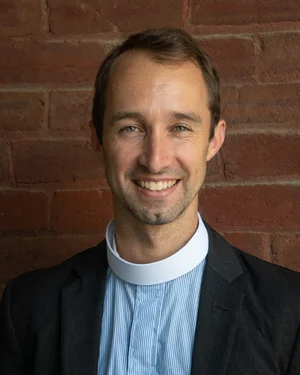
Sam Bush, “How to Tell a Good Story”
I have a question: How do you tell a good story? A skilled story teller, whether a grandmother or a groomsman, likely follows several rules – know your audience, use the element of surprise – but, according to a professional storyteller I once met, the most important rule is this: the teller must not be the hero of his own story. Why? For starters, nobody wants to hear how you shot the winning basket or saved a kitten from a burning building (trust me, keep it to yourself). In the words of Ralph Waldo Emerson, “Every hero becomes a bore at last.” Because a hero is not someone anyone can relate to.
We still try. We love to play the hero. We routinely embellish the details of our stories to position ourselves as the champion. With each telling, the fish gets bigger, the golf ball is putted farther away from the hole, the attendance at church grows a little larger. We think that to be impressive is to be loved, but the glory story not only runs the risk of turning history into mythology; it is simply uncompelling. The glory story is boring.
Today’s gospel reading is so riveting and timeless because it is the story of an anti-hero. Few people have been pigeon-holed so negatively as Doubting Thomas (other than his distant cousin, Lazy Susan). Thomas is on the wrong side of history. When the disciples tell him that they have seen the risen Jesus, he is not doubting as if he is a mixture of belief and unbelief. He’s entirely checked out. He speaks in no uncertain terms: "Unless I put my finger in the mark of the nails and my hand in his side, I will not believe." This is less an ultimatum and more a door slamming shut.
Thomas’ belief is based on a condition, the keyword being “unless.” Unless he puts his hand in Jesus’ side he will not believe. Truth be told, you and I live in the “unless.” Unless I get that job I will not be satisfied. Unless all my kids grow up healthy and well-balanced I will not find peace. Unless she apologizes to me I will never speak to her again. Our hope often hinges on the unless. Leave it to Jesus to blow the door right off the hinges. As John’s Gospel says, “Although the doors were shut, Jesus came and stood among them and said, “Peace be with you.” You see, Jesus knows that faith is not something that can be faked or forced as if it were an animal to chase down and domesticate. If belief is an animal it is a predator and we are the prey. Lucky for us, the predator is none other than the Lamb of God who says “Peace be with you.”
Thomas is not saved by his faith in Jesus; he and his faith are saved by Jesus. When Jesus invites Thomas to touch his side, Thomas falls to the ground and blurts out the most profound confession of faith in the entire Bible: “My Lord and my God!” It is not a decision but a compulsion. Thomas is not a hero, but a witness to the risen Lord.
When you take the details out of Thomas’ story, his story is your story. As much as we want to be the hero, we are often the anti-hero. Doubting, angry, fearful, failing, on the wrong side of our own personal histories. But what makes his story so profound is that his story is not about him; it is about God. That is one of the relieving natures of worship. We did not come to church today to read “Song of Myself,” but, rather, the song of our Savior. The story you will hear today is not the story of you, but the story of your redemption. It is anything but a glory story. Its hero is the ultimate anti-hero, a man “despised and rejected by men, a man of sorrows and acquainted with grief.” His victory of our salvation only won through the suffering and humiliation he endured on the Cross.
What does this mean for you and your story? Well, should your glory story ever turn into a tale of woe, remember: in God’s story, what looks like the ending is really just the middle. The BBC show, Rev (short for Reverend), is a good example. It is about an Anglican priest at a failing parish in inner-city London. The Reverend Adam Smallbone (played by Tom Hollander) is a hard worker. He loves his family. He means well. And he truly believes in God. But his belief is not enough to save him from total collapse. At one point, his church is doomed to close, he has kissed a woman on his staff (his marriage struggling in the wake). He finds himself exhausted, embarrassed, sitting on a park bench at sunrise when God shows up as Liam Neeson who is a jolly but unkempt man dressed in a mismatched track suit, holding a morning beer. By the way, I believe this depiction to be an accurate portrayal of the living God.
He sits and asks Adam what’s on his mind. “I’m trying to keep something alive,” Adam says, “but I don’t think I can do it.” In bad storyline fashion, Liam Neeson’s character rattles off a slew of cliches, “Ah, you know, I’ve learned a few things over the years. You can’t make an omelet without cracking some eggs. We are what we eat. You buy cheap, you buy twice” to the point where Adam says, “You can stop now.” After a pause, God puts his hand on Adam’s shoulder and says, “Adam, Adam. We all have our crosses to bear. I understand, Adam. I will always be here.” In the next frame, Liam Neeson is gone. But, for the first time in a while, Adam has some life in his eyes. The end of his story is right when God’s story gets interesting.
OK, but still, both Adam Smallbone and Doubting Thomas both had personal encounters with God. What about us? Jesus says, “Blessed are those who have not seen and yet have come to believe.” Is that description a good match for you today? Are you feeling blessed?
Either way, let me tell you the story of Ben Sasse, the former U.S. senator and college president who, after extremely successful careers in politics and academia, is now a hospice patient on day 99 of a four month cancer prognosis. In an interview with the New York Times this week, Ross Douthat asked him, “I assume you’ve prayed for healing? Not to be the guy who just beats the odds, but to be the miracle story, right? But God hasn’t answered those prayers yet so are you angry at God?”
And this is what Ben Sasse said, “No. I don’t know what the weaving together of the tapestry of full redemption should look like, but I know going through the period of suffering that I’m going through is a benefit because it is a winnowing. My soul thinks I should be God, and I want that to die. Cancer is terrible, but it is a stake against my delusional self-idolatry.” Now, I don’t use this illustration lightly. But this is a man who is neither the hero nor the author of his own story; a man who has nothing to hold onto except his belief that Jesus is holding onto him and says, “I understand. I will always be here.” Ben Sasse has been given the gift of faith and, by the grace of God, knows that what we think is the ending - death - is not even the middle. Because of the resurrection, it is only the beginning.
Wherever you are struggling to keep something alive, Jesus says, “Let me take that. Take me instead. I’m alive. I am the resurrection and the life.” He does not edit your story but tells an altogether new one. You may not be the hero of your story, but your story does have a hero, thanks be to God.
Amen.