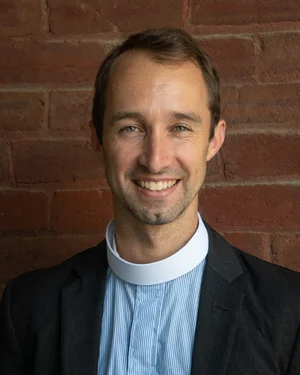
Sam Bush, “Is there a Doctor in the House?”
Let me tell you about a place. Chances are, you’ve been. It’s a place with many rooms, full of people from all walks of life - litigators and line cooks, architects and activists, fathers, mothers, sisters, brothers. They do not come by choice, but out of emergency. Some needs are common, others more urgent. In one room, there is relief and levity. In the next room, a devastating diagnosis is delivered. And for every time someone miraculously pulls through another person dies. It is the last place you want to be. But it might be the only place that can help you. The place I’m talking about, of course, is church.
There are many metaphors for church in the Bible — a boat, a house, a vineyard, a flock — but the church’s best working analogy is a hospital for sinners. They have plenty in common. Both are last resorts. You only go there when there is nowhere else to go. And most people don’t like being in either hospitals or church for plenty of reasons, but to that I’d say it all depends on who your doctor is. To be clear, don’t mistake the white collar for a white coat. I’m patient zero. Trust me, you don’t want me stitching you up. The doctor, of course, is Jesus. He says so himself in today’s gospel reading. Let’s take a look.
The passage introduces us to a man named Matthew, who is a tax collector. Tax collectors were Jewish citizens who worked for the Roman Empire. They took their own people’s hard-earned money just to give it to Caesar’s slush fund and then they skimmed off the top for their own personal gain. They were traitors and cheats, shunned by their families; banned from any house of worship and deemed so untrustworthy that they were not allowed to give testimony in court. But Jesus, conducting the worst job interview of all time, walks up to this bad seed, Matthew and says, “Tag, you’re it. Follow me.” Maybe it was a slow day at work, but for some reason Matthew gets up and follows Jesus.
The scene cuts to dinner at Matthew’s house which is full of riff raff and ne’er-do-wells. By this point, the Pharisees, the pious religious leaders are freaking out. They ask the disciples, “Why does your teacher eat with tax collectors and sinners? He’s setting a bad example. Think of what this says to children.” Overhearing the Pharisees from across the room, Jesus answers the question directly. “Those who are well have no need of a physician, but those who are sick.” Jesus taps Matthew, not because he fits the bill for a good disciple, but because Matthew is in need of care. This is a house call.
What sets Jesus the physician apart is how he provides a personalized treatment plan. To be clear, the church is, at best, a struggling hospital. It has always been and always will be flawed and inefficient. Just like healthcare, everyone has a theory about how to fix it. But fixing the system has never been this physician’s priority. The priority is the patient.
“Tell me where it hurts,” he says. Instead of a stethoscope, a listening ear; instead of pain killers, a comforting word. Jesus is not going to tell you to eat better or that you need to exercise more. This is not preventative care. It’s too late for that. He knows that if you were able to save yourself, you already would have. In fact, the one instruction he has for you is to be still.
Imagine a situation where you need acute care. You need to get stitches or a bone reset or an epidural. You are anxious and in pain. But imagine that your doctor is calm, kind and competent. He explains that what is about to happen is going to hurt, but that it is a necessary step. Your job is not to heal yourself or be ashamed of your need or to instruct the doctor as to how to do his job. Your job is to be still, to move as little as possible.
As people, we are so hellbent on health and wellness that being still does not even feel like an option. Fitness is next to godliness. Being still feels too much like death. But God has no use for your six-pack abs. He wants your knee pain, your torn achilles, your asthma. And your virtue leaves him unemployed. He wants your weakness, your fear, your sin. Being in the business of mending things, He is only interested in what is broken. And so, as T.S. Eliot once wrote, “The whole world is a hospital.” From Matthew the tax collector who has been poisoned by greed and ambition to the Pharisees who are plagued with self-righteousness, the doctor tends to the specific malady of each patient.
Where are you sick? Addiction, resentment, anxiety, regret? If there is nothing wrong with you, I’m not sure why you’re here. You don’t go to a hospital to show off how healthy you are. Your deepest hurts - the things you are ashamed of, the things you want to hide - are the very places the doctor needs to go. And if you’re looking for a cure, first comes the diagnosis. You cannot be healed unless you are sick. You cannot be comforted unless you mourn. You cannot be forgiven unless you have sinned.
And yet, by the grace of God, hope comes from the wound. You may have read the book When Breath Becomes Air by Paul Kalanithi, an accomplished neurosurgeon who was diagnosed with terminal lung cancer at the age of 36. In the epilogue, his wife Lucy depicts how his illness affected their marriage which was going through some problems - both spouses working around the clock as highly respected doctors. She writes, “His cancer diagnosis was like a nutcracker, getting us back into the soft nourishing meat of our marriage. We each joked to close friends that the secret to saving a relationship is for one person to become terminally ill. Conversely, we knew that one trick to managing a terminal illness is to be deeply in love - to be vulnerable, kind, generous, grateful."
You and I have a chronic illness called sin. We were born with it and, sadly, it will be the cause of death for each of us. You cannot put a bandaid on it. The cures we offer are only temporary. The soul's maladies have their relapses just like the body's. The only thing that will truly heal us is a heart-transplant. You see, the Great Physician’s ultimate treatment plan is to take your place on the gurney. By his wounds we are healed and by his death we have been given eternal life.
There’s a story in Anne Lamott’s book Bird by Bird about an eight year old boy whose sister had leukemia and needed a blood transfusion. After a blood test, it became apparent that the boy’s blood was compatible with his sister’s blood type so his parents asked if he would give his sister a pint of blood, explaining that it could be her only chance of living. He said he would have to think about it over night. This is what Anne Lammot writes:
The next day he went to his parents and said he was willing to donate the blood. So they took him to the hospital where he was put on a gurney beside his 6 year old sister. Both of them were hooked up to IV’s. The boy lay on his gurney in silence while the blood dripped into his sister; until the doctor came over to see how he was doing. Then the boy opened his eyes and asked, “How soon until I start to die?”
Now, obviously, this boy did not fully understand what was being asked of him. Jesus, however, the Great Physician, did. Rather than simply medicate our wounds, he gave his blood, shed for you and for many for the forgiveness of sins and the cure of souls. Consider yourself post-op, but in recovery. And what is his prescription? One sip by mouth once a week as needed (or by intinction which is when you dip the wafer, whatever, you know what I mean).
I’ll close with the powerful lyrics of one of our songs: Come, ye sinners, poor and wretched, weak and wounded, sick and sore; Jesus ready stands to save you, full of pity, love and pow’r: He is able, He is able, He is willing, doubt no more.
Amen.