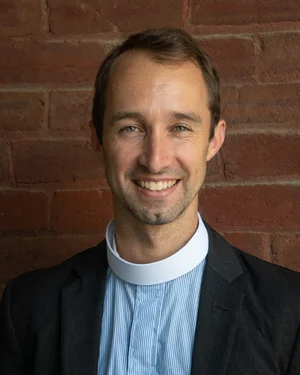
Sam Bush, “The Past isn’t Dead (But Neither is Jesus)”
Do you ever lie in bed, trying to go to sleep, thinking of some foolish thing you said five years ago, wishing you could rewrite history? I do. I remember exactly what you said and I think about it all the time. I mean, how could anybody be so foolish?
There’s a famous line from William Faulkner’s 1951 play “Requiem for a Nun” that has been quoted in movies, sermons and epigraphs: “The past is never dead. It’s not even past.” As much as we want bygones to be bygones, bygones have a way of being uninvited houseguests, don’t they? Whether they be painful memories or grief or regret, they show up unannounced, invite themselves in and pretty soon they’re stretched out on your couch eating your cheese curds, living rent free. As a result, many people never recover from their parents’ divorce. Or the one that got away. Or the loss of a loved one. Or a car accident. I mean, does anyone ever get over anything?
Someone who understands this as well as anyone is Joseph from our reading in Genesis. At the age of seventeen Joseph had an experience that would shape him forever. Here’s the backstory:
Joseph came from a blended family of twelve brothers, ten of which were half-brothers. Joseph’s father, Jacob, made no bones about who his favorite was. One Christmas, Joseph was given a Burberry cashmere Hastings trenchcoat while the rest of the boys got Kirkland Brand bomber jackets. Joseph flaunted his golden child status. He tattled on his brothers. He told them in great detail these elaborate dreams in which his brothers would bow down to him. A real teacher’s pet. One day, the family dysfunction reached a breaking point.
Jacob sends Joseph to check on his brothers who were shepherding their sheep in another county. His brothers see Joseph from a distance. By then their contempt had been smoldering for years. Righteous anger functions like a fire, doesn’t it? All it takes is a spark to set a fire going. “Let’s kill him,” one of them says, “and we’ll see what his dreams amount to.” But Judah, one of the older brothers, suggests something far more sinister, that they may as well make a few bucks and sell Joseph to a group of slave traders passing by on the way to Egypt. They rip off his coat. And, as he pleads, it says, “in anguish,” they sell him off for twenty pieces of silver.
A lot happens over the next six chapters. The story is as gripping as a Grisham novel, but here’s what you need to know. Joseph’s fortune rises and falls like the tide. Through an exhausting series of events, his story fluctuates from rags to riches three times over. But, through God’s divine appointment, Joseph ends up becoming Pharaoh’s right hand man. He goes from an Egyptian prison to having more power than any other living person.
Things are looking up. He is given a wife and has two sons, the first of which he names Manasseh which means making to forget. “For God,” Joseph says, “has made me forget all my hardship and all my father’s house.” Oh, but if only it were that easy. Joseph’s past is hardly dead. In fact, it comes to see him.
You see, through God’s divine appointment and under Joseph’s leadership, Egypt is the only country who is prepared when a famine strikes the land. All around, people are starving, including Joseph’s brothers who are forced to go to Egypt to buy grain. In great irony, they set up an appointment with the brother they betrayed thirteen years prior. They don’t recognize him – he’s all dolled up like a Pharoah – but he sure remembers them!
Karma is all teed up. With one word Joseph could return the favor by throwing them in jail or having them executed. First, he accuses them of being spies. He takes their youngest brother Benjamin and threatens to throw him in prison. But Judah – the one whose idea it was to sell Joseph off – says, “No. You see, we’ve already lost one brother. To lose Benjamin would finish our father off. He couldn’t take it. Take me instead.” Judah, the traitor to Joseph, offers to trade his own life for Benjamin.
And what happens? Joseph loses it. All the pain from the last that had been welling up comes springing forth. He orders his staff to clear out so that he can be alone with his brothers. He sobs so violently that all in Pharaoh’s household could still hear him. And then he comes clean. He tells them to come close. “I am Joseph. It’s me. The one you sold away.” And right when you expect him to bring down the hammer of justice he says, “Do not be distressed, or angry with yourselves, because you sold me here; for God sent me before you to preserve life.” In other words, if I hadn’t been sold into slavery Egypt wouldn’t have been ready for this famine and everyone would have died. You see? You’re not responsible. God is.” They end up reconciling. Joseph moves his family to Egypt where his father spends his remaining years alongside his long lost son.
Now, it is easy to sentimentalize this scene. Joseph crying, embracing his brothers like it's the end of an episode of Glee or Touched by an Angel. Frederick Buechner said, “To sentimentalize something is to sigh over the prettiness of it rather than to tremble at the beauty of it, which may make fearsome demands of us.” How does Joseph make peace with a life altering act of betrayal? How can he let his brothers off the hook so easily? It requires death. The death of his pride, of his concept of fairness, of his thirst for justice.
In his book How to Stay Married, Harrison Scott Key writes, “What is forgiveness, but burying the dead and being okay with it? What can be more impossibly necessary in this life? They say God doesn't keep a grade book, and I'm trying to throw mine away.
"Love keeps no record of wrongs," we hear so often in wedding ceremonies, and we smile like fools.” There is a cost to forgiveness. And the cost is one’s life.
Without God, this story ends like any Greek myth or Godfather movie. Lots of blood and revenge. But this story echoes God’s own story, a story that ends with plenty of blood. It’s just not ours. It’s His. Like Joseph was betrayed, he was handed over for a few silver coins, he fed our starving souls with his very body. God sent Jesus to preserve life at the cost of his own life. Whereas the Confucius proverb critiques revenge, saying, “Before you embark on a journey of revenge, dig two graves,” Jesus says otherwise: “One grave will do. Let it be mine.”
What about your past? What about the things that you can’t get over? Whether you identify with Joseph – something done unto you – or whether you identify with his brothers and it’s something you’ve done, you may want to forget something but are simply not allowed to.
To you, God offers consolation. Jesus insisted that we never get over what happened to him. Our communion service pays heed to his command to continue “a perpetual memory” of his death, a death that we relive every Sunday. We refuse to get over it. Should we ever attempt to “move on” from the crucifixion, we would be moving away from the source of our salvation. Ironically, in order to experience true healing, we go deeper into the wounds of Christ. The Cross was never meant to help us make sense of the past. It was meant to redeem the past.
It brings to mind Garrison Keillor’s famous retelling of a family memory in which his Uncle John, was asked to bless the food before dinner: Everybody in the family knew that Uncle John couldn’t pray without talking about the cross and crying. Sure enough, Uncle John prayed, talked about the cross, and cried. Meanwhile, the rest of us shifted nervously from one foot to the other and longed for the prayer to end. All of us knew that Jesus died on the cross for us, but Uncle John had never gotten over it.
In just a few minutes, as we kneel before the altar, we cling to the crucified as he clings to us and we give thanks that God has not only secured our future but redeemed our past. In the death and resurrection of Jesus Christ, we find that the past is never dead. But neither is Jesus. In fact, he is very much alive.
Amen.