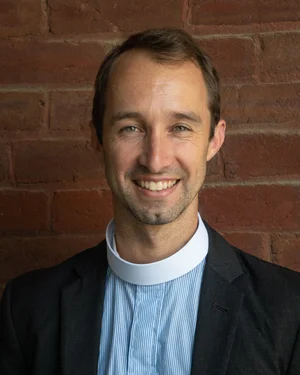
Sam Bush, “Falling Short”
Back in my mid-twenties I was feeling aimless and anxious. I was single. I had no career trajectory. So I decided to get into running, that running was going to be my thing, that people would refer to me as “That guy who runs.” I signed up for the Charlottesville 10-Miler and trained for a few weeks. The morning of the race, I ran into a friend at the starting line and we decided we would run together. For the first few miles we were burning rubber, passing people left and right like a couple of running backs headed for the endzone. But five miles in I started losing steam. The conversation between me and my friend became one-sided. I was gasping for air when he casually shared with me his plans to go to the Air Force Academy that fall. That’s when I suggested we find different running partners. From that point, the miles dragged on like a bad dream. By mile nine, many of the people I had passed were now passing me. And then it all went dark. I woke up on a stretcher being lifted into an ambulance having fainted fifty feet from the finish line.
In case you are hoping for a hint of redemption in this story, there isn’t one. I passed out so close to the finish line my friends later checked to see if the medical team had carried me across on the stretcher. It turns out they had not. My name was at the bottom of the race results next to the letters DNF for Did Not Finish. And that was the end of my running phase. I have since taken up birdwatching which is easier on the knees.
What about you? Have you ever fallen short of something? Someone’s expectations? Your own hopes for the way your life would go? A time when you tried your best and your best was not enough? Failure is an ugly thing. We like to put a spin on failure, as if it is always a stepping stone to success, but sometimes falling short reveals the painful truth that we are not who we thought we were and that we are not enough.
If anyone understands the painful experience of falling short, it is Moses, the most important prophet in the history of Judaism. From the bottom of his staff, the Red Sea parted. In his arms, God’s Ten Commandments were carried down from Mount Sinai. For forty years, Moses led the Israelites through the wilderness. He was their mediator, standing in the gap between God and God’s people, delivering laws, settling disputes, pleading for mercy on their behalf. The Israelites final destination was Cannan, known as the Promised Land because God had been promising it for almost 500 years. This Promised Land would be a home; a place to belong. It represented peace and rest. And they were almost there.
But at the end of his life, Moses goes up to the top of a mountain that overlooks the Promised Land when God intervenes, saying “I have let you see it with your eyes, but you shall not cross over there.” And then, “at the Lord’s command,” it says, Moses dies. After forty years of leading the Israelites, he fell short just shy of Canaan’s borders.
What kind of carrot-on-a-string game is this? What could have possibly disqualified Moses after his faithful service as a prophet? I’ll tell you, but you’re not going to like it. One day, back in the wilderness, the Israelites were complaining of thirst. God instructed Moses to speak to a rock that would then spring forth water. But Moses was fed up with his people. They had rebelled and complained for too long and Moses had had enough. Taking matters into his own hands he struck the rock with his staff, disobeying God’s specific command. The rock had always served as a picture of God’s grace and generosity, but Moses shouted, “Listen you rebels! Must we bring you water out of this rock?” Rather than a mediator, he was an accuser. Water did flow from the rock, but Moses’ rebellious act would ultimately exclude him from the Promised Land.
This might sound like a minor infraction, deserving of a slap on the wrist at most. Except it reveals an important trait of God’s character: His holiness. Here we find that God’s law does not operate on a sliding scale but a fixed rate. And that rate is total perfection. Here, we find that God does not call us to be good, but perfect. It may sound harsh, but God’s holiness is unsentimental. If you fly too close to the sun and catch fire, it is not the sun’s fault. The sun is simply being what it is. Likewise, God’s holiness is so bright, so pure, so strong that we cannot withstand its presence.
Moses was the greatest prophet of Israel. Our passage says, “He was unequaled.” And yet, God’s law which demands perfection is the great equalizer. According to God’s standard, none of us have a chance. Paul’s letter to the Romans says, “For all have sinned and fall short of the glory of God.” Prophets, project managers, prostitutes, priests. In the race for righteousness, no one crosses the finish line.
If you think Christianity is a moral enterprise in which Jesus is your personal trainer, this passage reveals that you are not in a race, you are on a hamsterwheel. If your focus is your own spiritual fitness level, you will, at best, burnout. Far worse would be that you start judging other people’s fitness levels. If you ever feel like a frontrunner in any kind of race, be it status or physique or wealth or even virtue, let Moses be your cautionary tale. Even the greatest among us are unworthy in the eyes of God.
If, however, you find yourself at the back of the pack, if you have given up on winning or if your body has simply given out, there is hope. For there was once a man who came not for the healthy but for the sick, not for the winners, but for the losers, not for the righteous, but sinners. He would serve as a mediator between us and God, but not only as a man, but God Himself in the flesh.
As God’s holiness functions like the burning sun, Jesus would function as the Light of the World. Where the Law of God gives us no leg to stand on, Jesus stands on our behalf. The theologian John Calvin said, “Moses had no other intention than to invite all men to go straight to Christ.” Because while Moses gave us the Law, Jesus alone fulfilled it. We are not saved by the example of Moses, but through the death and resurrection of Jesus Christ. Whereas Moses took matters into his own hands and struck the rock, Jesus took matters into his own hands and was struck down for our sake. On our own strength, we failed to cross the finish line. But from the Cross, Christ proclaimed, “It is finished.” The race is won. Christ is the victor. And you are his prize. And through his victory, we will be ushered into the Promised Land.
What does this have to do with your life? Well, if this message gets through at all, you may begin to rest in Jesus more than the strength of your character or even the strength of your faith. You may start to believe that, as the poet Tanner Olson says, “Life is not a race and you are not behind.” Trusting that Jesus has won the race, you may feel free to run yourself, but out of joy instead of out of fear. Knowing that Jesus’ blood has cleansed you of your sin so that you are presented holy and blameless to God, you may be able to receive criticism or carry yourself with humility. But let’s not get too carried away. If you’re like me, your life will be marked by a series of times where you fall short – as a father, as a mother, as a friend or coworker, as a believer, as a sinner. It is in those times that the grace of God will actually mean something to you.
There is, in fact, a hint of redemption in my 10-Miler story. As I was being loaded into the ambulance, exhausted and embarrassed, a man I knew from Christ Church came into view. His name was Bill, he was from Texas. “Sam! I’ll come meet you in the hospital!” I remember him saying. Sure enough, as I lay helpless in the Emergency Room, Bill showed up. A few hours later, he came back to drive me home. The next day he called to check in, just to see how I was doing. As much as we think God will meet us in our victories, the Cross shows us otherwise. God’s redeeming love burns brightest in the dark, in our failure and our shame. It comes to us when we have no power in ourselves to help ourselves. It restores us. It assures us that where we fail, God succeeds. Where we fall short, God delivers.
Amen.